
Expert Security Officers in Austin, Texas
Security is only as reliable as the individuals behind it. Ranger Security Agency recruits, screens, and deploys DPS-licensed expert security officers across Austin, from Downtown and The Domain to South Austin, East Austin, and every metro zone, with qualifications that go well beyond what Texas law requires and a deployment standard built around your specific property.
WHAT EXPERT ACTUALLY MEANS
The Standard Behind the Title
In Texas, the term “security officer” covers a wide spectrum — from individuals who satisfy the state’s bare-minimum 6-hour training requirement to career security professionals with years of law enforcement, military, or specialized private-sector experience. The difference between those two profiles is not merely one of credentials on paper. It is a difference in judgment under pressure, situational pattern recognition, and the capacity to make consequential decisions correctly when no supervisor is standing next to them.
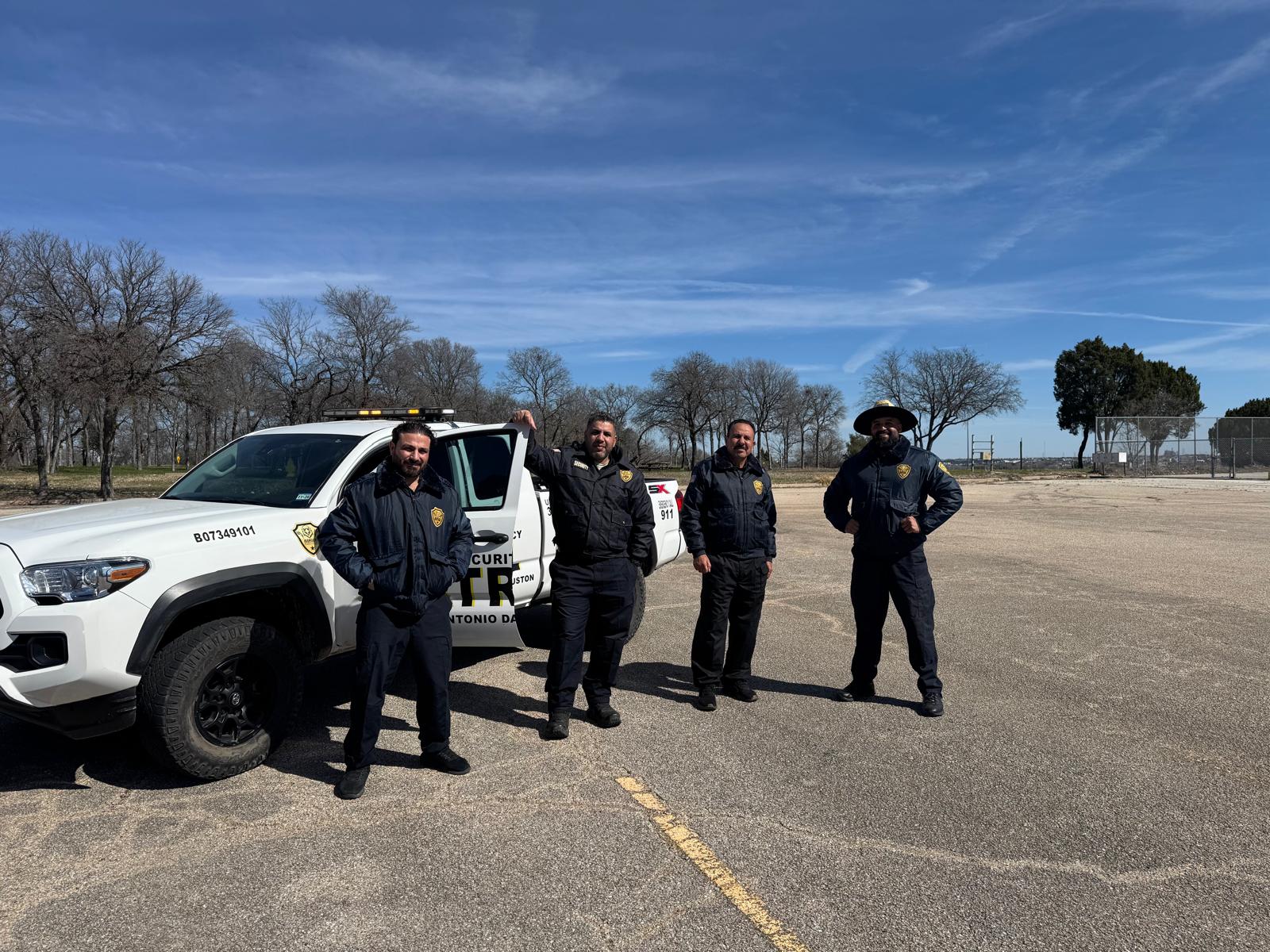
At Ranger Security Agency, “expert” is an operational qualification — not a marketing descriptor applied uniformly. Officers are selected through a multi-stage hiring process, hold current Texas DPS licenses matched to their assignment type, pass background investigations that go three databases deep, and receive a property-specific briefing before their first shift at any Austin site. Officers with prior law enforcement or military backgrounds are actively recruited and prioritized for complex or higher-risk deployments — armed environments, properties with documented incident histories, and sites where the quality of an officer’s judgment is the primary security variable.
on-site.
| “The difference between a guard and an expert officer is the same as the difference between someone who knows the rules and someone who understands the situation.” — Ranger Security Agency, Training Division |
Austin’s security landscape has grown materially more complex as the city has expanded. The Domain’s corporate campuses, South Congress retail, UT campus-adjacent properties, Downtown financial institutions, and the growing multi-family residential stock across North and South Austin all present environments where the quality of the individual officer — not just the presence of a uniformed body — determines outcomes. This page covers how Ranger selects, trains, and deploys the officers who carry our name at Austin properties. For specific service types, our armed security guard, unarmed security guard, and 24-hour security guard pages cover each deployment type in full operational detail.
How Ranger Vets, Trains, and Licenses Every Austin Officer
Every officer Ranger deploys to an Austin property has cleared a qualification process designed to exceed Texas DPS requirements and eliminate the risk of deploying undertrained or unreliable personnel where it matters most.
Texas DPS Level II and III Licensing
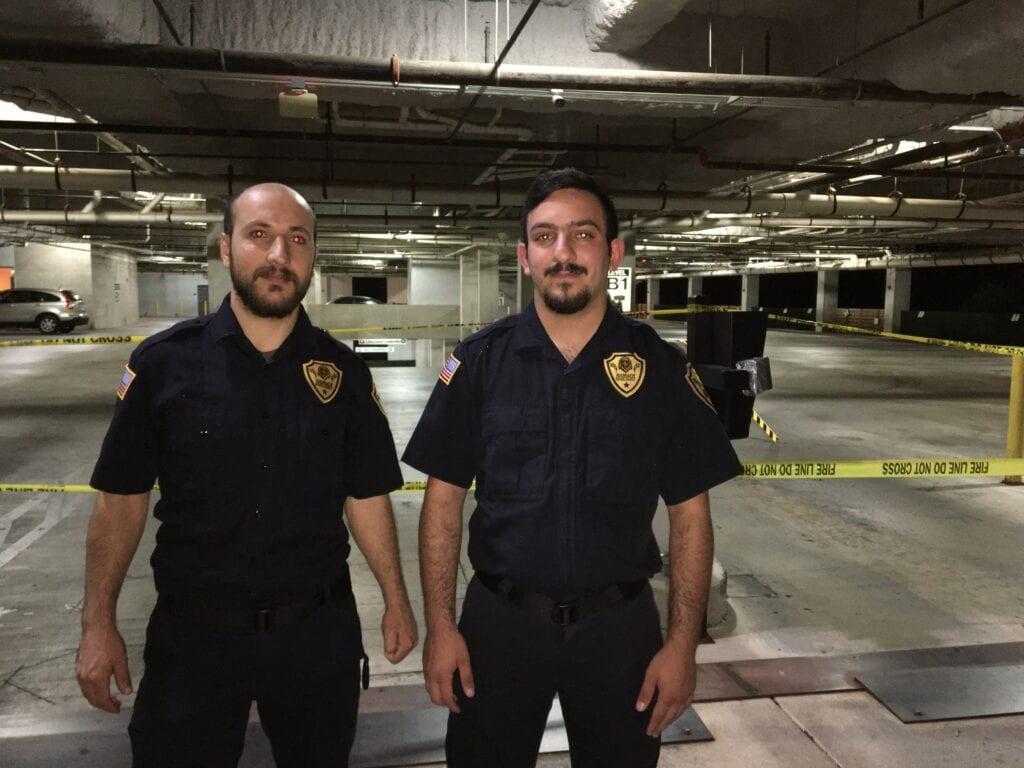
All officers hold current DPS Private Security Bureau licenses matched to their assignment type — Level II (non-commissioned) for unarmed deployments, Level III (commissioned) for armed assignments. License numbers are verified before every assignment, and renewal deadlines are tracked centrally, so no officer operates on a lapsed credential without anyone realizing it. A lapsed armed officer at a client site is a liability for the client, not just the agency — and Ranger treats that accordingly.
Three-Layer Background Investigation
Ranger’s screening goes well beyond DPS minimums. Every candidate undergoes criminal history checks through the FBI national database, the Department of Justice, and Texas state and local law enforcement systems. Any felony conviction, disqualifying misdemeanor record, or domestic violence history ends the application immediately — no exceptions, no case-by-case reviews for excluded offenses. Officers who clear this process represent a measurably lower risk profile than those hired under standard minimal-compliance screening.
Drug Screening — Pre-Hire and Ongoing
Pre-hire drug panels are mandatory for every candidate. Employment conditions include random on-duty testing throughout the officer’s tenure, and officers who test positive are removed from active deployments immediately. The random testing schedule is not announced in advance — it is a standing condition of employment. The distinction matters: a program that tests only at hire creates a different risk profile than one that tests throughout employment, because the hire-only approach does not protect against post-hiring substance issues.
Military and Law Enforcement Recruitment
Officers with prior military service or law enforcement careers bring tactical decision-making experience that no training curriculum fully replicates. The judgment developed through years of real-world threat assessment, use-of-force decision-making, and high-pressure situational management translates directly to private security effectiveness. Ranger actively recruits from these populations and prioritizes their placement at complex deployments, such as armed sites, high-risk events, and properties, where an officer’s judgment under pressure is the defining security variable.
Site-Specific Post Order Orientation
Every officer assigned to an Austin client site receives written post orders specific to that property, covering physical layout, access control procedures, escalation protocols, emergency contact hierarchy, client-specific instructions, and any known risks or historical incidents relevant to the post. Reviewing and signing post orders before the first shift is an operational requirement, not a courtesy. An officer who arrives at your property not knowing your site’s specific protocols is not an officer who has been properly prepared.
Multi-Level Interview Screening
Candidates pass through structured multi-stage interviews that evaluate situational judgment, professional conduct, communication clarity, and character — not just technical competence. The interview process is specifically designed to identify how an officer will handle difficult or ambiguous situations when management is not present, because that is precisely the context that defines most real-world security encounters. Technical minimum requirements are the entry bar; judgment and conduct are the selection criteria.
100%
DPS license verified before every shift
3-Layer
Background check — FBI, DOJ, and Texas DPS
Metro-Wide
All Austin neighborhoods and the surrounding counties
24 / 7
Day, evening, and overnight deployments available
TRAINING STANDARDS
Ranger Standards vs. Texas Minimums
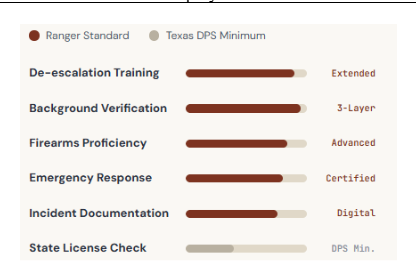
Texas law sets a training floor. Ranger treats it as a starting point. Here is how our standards compare across the key competency areas that determine real-world officer effectiveness in Austin deployments.
AUSTIN COVERAGE AREAS
Neighborhoods and Areas Served Across Austin
Ranger deploys expert security officers across the full Austin metro — not just central business districts. Officer briefings include neighborhood-specific context as part of every site orientation.
Downtown / Congress Avenue
Financial institutions, government buildings, high-visibility retail, and event venues require professionally presented officers with strong access control discipline.
The Domain — North Austin
Corporate campuses, luxury retail, and mixed-use developments where officer demeanor is as important as credentials — tenants and guests expect a polished, professional presence.
South Congress (SoCo)
Eclectic retail corridor requiring officers who balance visible deterrence with an approachable, neighborhood-appropriate presence that matches SoCo’s distinct character.
East Austin
Rapidly developing mixed-use, industrial, and active construction zones require officers who adapt to both new development environments and established commercial properties.
UT / West Campus
Student housing and campus-adjacent properties with late-night foot traffic and density-driven property crime patterns require approachable, alert officers around the clock.
Cedar Park / Round Rock
Northern suburban commercial and industrial inventory — the same officer quality standard as central Austin deployments, without a premium for the zip code.
Expert Security Officer FAQs — Austin, TX
What qualifications do Ranger Security Agency officers have in Austin, TX?
All Ranger officers deployed in Austin hold active Texas DPS licenses — Level II for unarmed deployments and Level III for armed assignments. Beyond state minimums, they complete multi-source background verification through the FBI and Texas DPS, pre-hire drug screening with ongoing random testing, conflict resolution and de-escalation training beyond the state curriculum, and site-specific post-order orientation before their first shift at any client property. Officers with prior law enforcement or military backgrounds are prioritized in hiring and assigned to higher-complexity deployments — including armed environments, executive protection details, and properties with documented incident histories where sound judgment under pressure is the defining qualification, not just technical competence.
How does Ranger's background check process work for Austin officers?
Ranger runs a three-layer background investigation that goes beyond Texas DPS requirements. Every candidate undergoes criminal history checks through the FBI national database, the Department of Justice, and Texas state and local law enforcement records. Any felony conviction, disqualifying misdemeanor, or domestic violence history ends the candidacy — no exceptions, and no case-by-case reviews for disqualifying offenses. A pre-hire drug panel is also mandatory, and random on-duty testing is a standing condition of employment throughout the officer’s tenure. The practical result is that officers who clear Ranger’s process represent a materially different risk profile than those hired through minimal-compliance screening programs — a distinction that matters to clients who are responsible for the safety of their employees, residents, or customers.
How many training hours do Ranger officers complete before deployment in Austin?
Texas DPS requires a minimum of 6 training hours for non-commissioned security officers and additional firearms-specific hours for Level III commissioned officers. Ranger supplements those state minimums with instruction in conflict de-escalation, emergency response procedures, digital incident documentation, and site-specific orientation. Officers assigned to specialized environments — healthcare facilities, data centers, large-scale public events, and financial institutions — receive environment-specific briefings on top of baseline training. Critically, no officer is deployed to a client site without having reviewed and signed site-specific post orders for that property. There is no learning period at the client’s expense. The officer who shows up for their first shift already knows your site’s layout, escalation protocols, emergency contacts, and standing instructions.
Deploy Expert Officers at Your Austin Property
Contact Us Today!
DPS-licensed, background-verified through three databases, and site-briefed before day one. Request a proposal and receive a tailored officer deployment plan within one business day.